
If you want your business website to appear on Google, choosing the right SEO keywords is one of the most important steps in your SEO strategy.
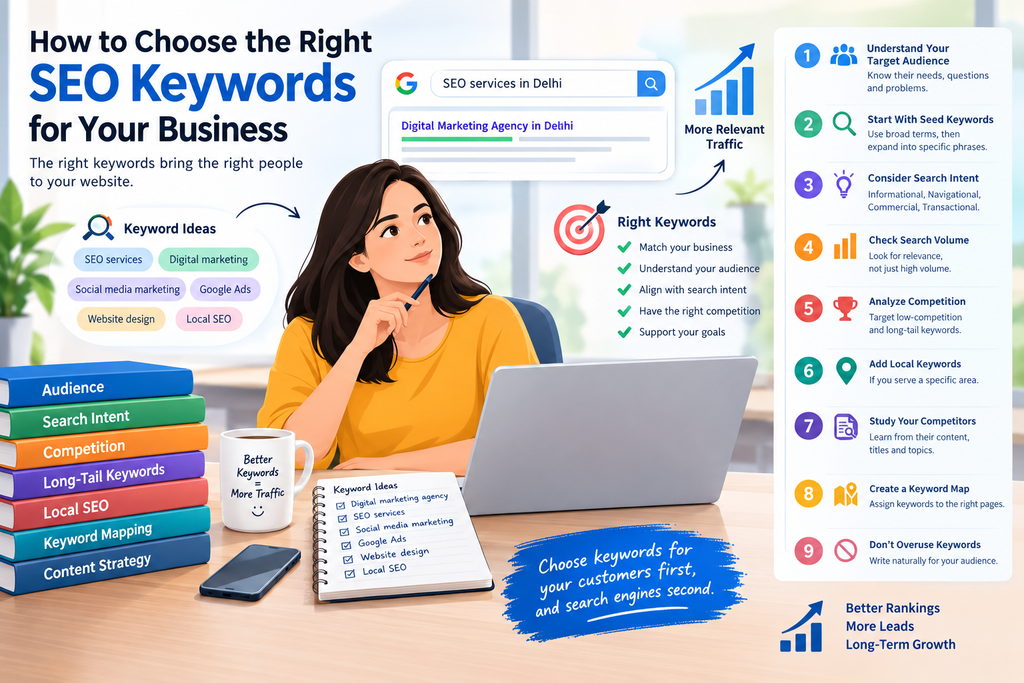
Keywords are the words and phrases people type into search engines when they are looking for information, products, or services. When you understand what your potential customers are searching for, you can create content that matches their needs and improves your chances of attracting relevant organic traffic.
However, choosing keywords is not simply about finding the words with the highest search volume. The right keywords should match your business, target audience, search intent, competition, and goals.
In this guide, we’ll explain how to choose the right SEO keywords for your business and how you can use them effectively.
What Are SEO Keywords?
SEO keywords are words or phrases that describe what a person is searching for on Google or another search engine.
For example, if you run a digital marketing agency, potential customers might search for:
- Digital marketing agency
- SEO services
- SEO agency in Delhi
- Social media marketing services
- Google Ads agency
- Digital marketing agency for small businesses
These phrases can become potential keywords for your website.
When your website provides useful and relevant information around these searches, search engines can better understand your content and determine when it may be useful to searchers.
1. Understand Your Target Audience
Before using any SEO keyword tool, understand who your customers are.
Think about the questions your customers ask, the problems they have, and the solutions they are looking for.
For example, a local restaurant might target searches such as:
“best restaurants near me”
while a web design company might target:
“website designer for small business.”
These audiences have completely different needs.
Ask yourself:
- Who are my ideal customers?
- What problems are they trying to solve?
- What products or services are they searching for?
- What questions do they ask before purchasing?
- Where are they located?
The better you understand your audience, the easier it becomes to identify useful keywords.
2. Start With Broad Seed Keywords
Seed keywords are simple words or phrases that describe your main products, services, or topics.
For example, if you own a digital marketing agency, your seed keywords could include:
- Digital marketing
- SEO
- Social media marketing
- Google Ads
- Website design
- Content marketing
These keywords provide a starting point for finding more specific search terms.
You can then expand them into longer and more targeted keyword phrases.
For example:
SEO → SEO services → SEO services for small businesses → SEO services in Delhi
This process can help you discover keywords that are more closely connected to your target customers.
3. Consider Search Intent
Search intent is the reason behind a person’s search.
Understanding intent is extremely important because two keywords can look similar but represent completely different customer needs.
The main types of search intent include:
Informational Intent
The user wants to learn something.
Examples:
- What is SEO?
- How does SEO work?
- How to improve Google rankings?
Navigational Intent
The user is looking for a specific website or business.
Examples:
- PulseMarketing
- Google Search Console login
Commercial Intent
The user is researching options before making a purchase.
Examples:
- Best SEO agency in Delhi
- Best website design company
- Google Ads agency reviews
Transactional Intent
The user is ready to take action.
Examples:
- Hire SEO agency
- Buy running shoes online
- Book digital marketing consultation
For business websites, commercial and transactional keywords can often be especially valuable because they may attract people closer to making a purchasing decision.
4. Check Keyword Search Volume
Search volume tells you approximately how often people search for a particular keyword during a given period.
A keyword with high search volume may look attractive, but high volume doesn’t automatically mean it’s the best keyword for your business.
For example, ranking for:
“digital marketing”
may be much more difficult than ranking for:
“digital marketing agency in Delhi for startups.”
The second keyword may have fewer searches, but the people searching it could be more relevant to your business.
Don’t chase search volume alone. Chase relevance.
5. Look at Keyword Competition
Competition is another important factor.
Broad keywords usually have many websites competing for the same search terms.
For a new or small website, targeting extremely competitive keywords can take considerable time and resources.
Instead, consider combining:
- Low-competition keywords
- Long-tail keywords
- Local keywords
- Service-specific keywords
- Question-based keywords
For example, instead of immediately targeting:
“SEO”
you could target:
“SEO services for small businesses in Delhi.”
More specific keywords can sometimes provide a better opportunity to reach your ideal audience.
6. Use Long-Tail Keywords
Long-tail keywords are longer and more specific search phrases.
Examples include:
“digital marketing agency in Delhi for startups”
“SEO services for local businesses”
“how to improve local SEO for a small business”
Long-tail keywords generally have a more specific intent than broad keywords.
They can also help you create highly focused content that answers exactly what a searcher wants to know.
For blog content, long-tail keywords are particularly useful because they can inspire article topics, FAQs, and detailed guides.
7. Add Local Keywords If You Serve a Specific Area
If your business serves customers in a particular city or region, local SEO keywords can be extremely useful.
For example:
- Digital marketing agency in Delhi
- SEO company in Delhi
- Website designer in Delhi
- Social media marketing agency in Delhi
Adding location-based keywords helps communicate where your business operates.
However, don’t add your location unnaturally to every sentence. Use local keywords naturally in important areas such as page titles, headings, content, URLs where appropriate, and other relevant SEO elements.
8. Study Your Competitors
Your competitors can provide useful keyword ideas.
Search Google for the services you offer and look at the businesses ranking on the first page.
Study:
- Their page titles
- Headings
- Service pages
- Blog topics
- FAQs
- Content structure
You can identify topics and keywords that are relevant to your industry.
However, don’t simply copy your competitors.
Use their strategies as research, then create content that is more useful, original, clear, and relevant to your audience.
9. Create a Keyword Map
Once you have a list of keywords, don’t use all of them on one page.
Instead, assign keywords to specific pages.
For example:
Homepage: Digital marketing agency in Delhi
SEO Service Page: SEO services in Delhi
Social Media Page: Social media marketing services
Google Ads Page: Google Ads management services
Blog: How to Choose the Right SEO Keywords for Your Business
This process is called keyword mapping.
It helps prevent multiple pages from competing against each other for the same primary keyword and gives every page a clear SEO purpose.
10. Don’t Overuse Keywords
One of the biggest SEO mistakes is keyword stuffing.
Keyword stuffing means repeatedly using the same keyword in an unnatural way simply to increase its frequency.
For example, writing:
“SEO services in Delhi are the best SEO services in Delhi for businesses looking for SEO services in Delhi…”
doesn’t make the content better.
Search engines are designed to understand context and meaning, so focus on writing naturally for your audience.
Use your primary keyword where it makes sense and include related terms naturally throughout the content.
Final Thoughts
Choosing the right SEO keywords is about more than finding keywords with high search volume.
You need to understand your audience, identify their search intent, analyze competition, consider long-tail and local keywords, study competitors, and map keywords to the right pages.
The best keyword is not necessarily the one with the most searches. It is the keyword that connects what your audience wants with what your business provides.
Start with a small group of highly relevant keywords, create genuinely useful content around them, monitor your results, and improve your strategy over time.
With the right keyword research and a consistent SEO strategy, your website can attract more relevant visitors, generate better leads, and build stronger visibility in search results.
Remember: Choose keywords for your customers first and search engines second. When your content genuinely satisfies search intent, you’re building SEO that can support long-term business growth.