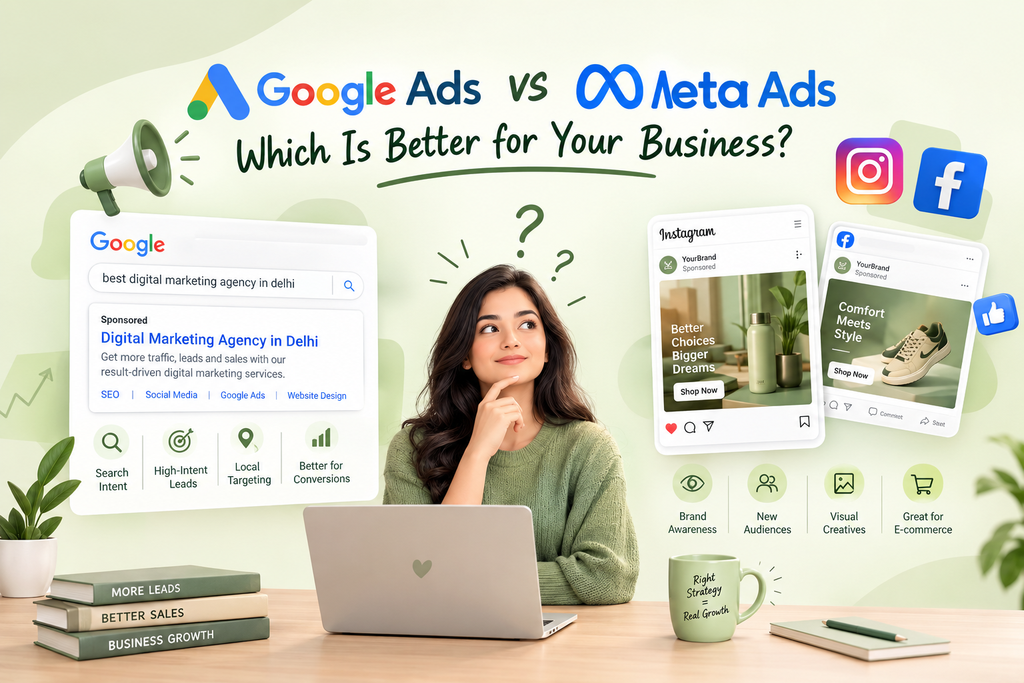
If you want to grow your business online, paid advertising can help you reach potential customers faster than organic marketing alone. Two of the most popular advertising platforms are Google Ads and Meta Ads (Facebook and Instagram).
But which one is better for your business?
The answer depends on your goals, audience, budget, and the type of product or service you offer. Google Ads is often powerful for reaching people who are actively searching for something, while Meta Ads can be excellent for creating awareness, reaching new audiences, and generating interest.
In this guide, we’ll compare Google Ads vs Meta Ads and help you understand which platform may be the right choice for your business.
What Are Google Ads?
Google Ads is Google’s online advertising platform. Businesses can create advertisements that appear across Google Search, YouTube, Google Maps, and other Google properties.
One of the biggest advantages of Google Ads is search intent.
For example, if someone searches for:
- “digital marketing agency in Delhi”
- “best website designer near me”
- “SEO services for small business”
- “buy running shoes online”
they are already looking for a product or service.
Your advertisement can appear when that person is actively searching for what you offer.
This makes Google Ads particularly useful for businesses that want to generate high-intent leads, enquiries, calls, bookings, or sales.
What Are Meta Ads?
Meta Ads are advertisements displayed across platforms owned by Meta, primarily Facebook and Instagram.
Unlike Google Search Ads, Meta Ads generally don’t wait for someone to search for your product or service. Instead, businesses can reach people based on factors such as their interests, behaviour, demographics, location, and interactions.
For example, a clothing brand could show Instagram ads to people who are interested in fashion, online shopping, or similar products.
Meta Ads can therefore be useful for brand awareness, product discovery, audience building, engagement, leads, and online sales.
Google Ads vs Meta Ads: The Main Difference
The biggest difference is user intent.
With Google Ads, people often come to Google because they already have a problem or need and are searching for a solution.
With Meta Ads, people may not be actively looking for your product. Your advertisement introduces your product or service to them while they are browsing Facebook or Instagram.
Think of it this way:
Google Ads: “I need this. Let me search for it.”
Meta Ads: “I wasn’t looking for this, but this looks interesting.”
Both approaches can be highly effective when used correctly.
Google Ads vs Meta Ads: Which Is Better for Leads?
If your main goal is generating leads from people who are already searching for your service, Google Ads can be a strong choice.
For example, a person searching for “dentist near me” or “digital marketing agency in Delhi” already has an immediate requirement.
Google Search Ads can put your business in front of that person at the right moment.
Meta Ads can also generate leads through lead forms, landing pages, WhatsApp campaigns, and other conversion-focused campaigns. However, the audience may not have the same level of immediate purchase intent.
Best for high-intent leads: Google Ads
Best for discovering and nurturing potential customers: Meta Ads
Which Platform Is Better for Brand Awareness?
Meta Ads usually have an advantage when it comes to visual brand awareness.
Facebook and Instagram allow businesses to use:
- Images
- Videos
- Reels
- Carousels
- Stories
- Creative promotional formats
This makes Meta particularly useful for brands that depend heavily on visual content.
For example, fashion brands, restaurants, beauty businesses, travel companies, creators, and lifestyle brands can use engaging visuals to introduce their products to new audiences.
Google Ads can also support brand awareness through YouTube and Display campaigns, but Meta is often a natural fit for social-first brands.
Which Is Better for E-commerce?
Both platforms can work well for e-commerce businesses, but they play different roles.
Google Ads can capture people who are actively searching for products. Someone searching for “wireless headphones under ₹3000” may already be close to making a purchase.
Meta Ads can create product discovery by showing visually appealing products to potential customers based on their interests and behaviour.
For many e-commerce brands, using both platforms together can be more effective than choosing only one.
Meta can help generate demand, while Google can capture existing demand.
Google Ads vs Meta Ads: Cost
There is no fixed cost for either platform.
Your advertising cost can depend on:
- Industry
- Competition
- Target audience
- Location
- Keywords
- Ad quality
- Campaign objective
- Landing page experience
- Conversion rate
- Budget
Google Ads can become expensive in highly competitive industries because businesses compete for valuable keywords.
Meta Ads may offer lower costs for reaching large audiences, but inexpensive clicks don’t automatically mean profitable customers.
The important metric isn’t simply how much a click costs. You should focus on the cost of acquiring a customer or qualified lead and the revenue generated from your campaigns.
Which One Should Your Business Choose?
Choose Google Ads if:
- Customers actively search for your product or service.
- You want high-intent leads.
- You want phone calls, enquiries, bookings, or direct purchases.
- Your business serves a specific location.
- People already know they need what you offer.
Choose Meta Ads if:
- Your business relies heavily on visual content.
- You want to build brand awareness.
- You want to reach new audiences.
- You sell products online.
- You want to promote offers, launches, or campaigns.
- Your audience spends significant time on Instagram or Facebook.
Should You Use Google Ads and Meta Ads Together?
For many businesses, the best answer isn’t Google Ads vs Meta Ads.
It’s Google Ads + Meta Ads.
A combined strategy can help you reach customers at different stages of the buying journey.
For example, Meta Ads can introduce your brand to a potential customer. That person may later search for your business on Google. Your Google Ads campaign can then capture that existing search demand.
You can also use remarketing to reconnect with people who visited your website, interacted with your content, or showed interest in your products or services.
This creates a more complete advertising strategy rather than depending on a single platform.
Final Verdict: Google Ads or Meta Ads?
There is no universal winner.
Google Ads is generally stronger for capturing existing demand and reaching people with high purchase intent. Meta Ads is generally stronger for creating awareness, discovering new audiences, and visually promoting products or services.
The right platform depends on your business goals, target audience, industry, budget, and customer journey.
If you’re a local service business, Google Ads may be a great starting point. If you’re building a visual consumer brand, Meta Ads may provide strong opportunities. And if your budget and strategy allow it, combining both platforms can help you reach customers before, during, and after their buying journey.
The most important thing is not simply running advertisements. It’s creating the right strategy, targeting the right audience, using compelling creative, sending visitors to a relevant landing page, and continuously measuring and optimizing your campaigns.
Ready to grow your business with paid advertising? A well-planned Google and Meta Ads strategy can help you reach the right audience and turn advertising spend into measurable business growth.